 Now under new ownership & part of the Arista Recovery Network! For more information,


When your child is in crisis, life feels like walking on thin ice. One day they’re laughing at the dinner table, the next they’re locked in their room, their eyes glazed over, or they’re storming out to “meet friends” you don’t trust.
You’re left wondering: Is it drugs? Is it depression? Is it both?
The truth is, for many young adults, substance use and mental health struggles are tightly woven together. One doesn’t just “cause” the other—they feed off each other, creating a cycle that can feel impossible to break. That’s why dual diagnosis treatment is so important. It doesn’t force a choice between treating mental health or treating substance use. It does both—because both matter.
Why Substance Use and Mental Health Are So Often Connected
For young adults, substance use isn’t always about “partying.” More often, it’s an attempt to cope.
- Anxiety can push someone toward alcohol or marijuana as a quick “off switch.”
- Depression can make stimulants look like an energy boost.
- Trauma can drive a desperate search for numbness.
But the relief is short-lived. Alcohol may calm nerves for a night, only to magnify anxiety the next day. Stimulants may help with focus for a few hours, but the crash can feel like hopelessness. What started as “managing” becomes self-sabotage.
This is the hidden link: young adults aren’t just “using drugs.” They’re trying to self-medicate—and it backfires.
The Cycle That Keeps Young Adults Stuck
Think of it like a seesaw.
On one side is mental health: depression, anxiety, trauma, or mood swings. On the other side is substance use. Every time one side tips, the other reacts.
- Mental health symptoms rise → They drink or use drugs to cope.
- Substance use increases → Their brain chemistry shifts, making symptoms worse.
- Symptoms worsen → They lean harder on substances.
The cycle keeps turning until your child feels trapped in a loop with no exit.
This is why many parents describe feeling like they’ve lost their child twice—once to mental health, and once again to drugs or alcohol.
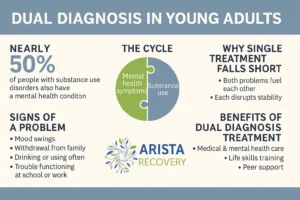
Why Single-Focus Treatment Falls Short
Imagine a doctor treating only one side of a broken bone. It wouldn’t heal right. That’s what happens when treatment focuses only on substance use or only on mental health.
- If treatment only addresses drugs and alcohol: The depression, trauma, or anxiety underneath stays unhealed. That untreated pain makes relapse almost certain.
- If treatment only addresses mental health: The ongoing substance use keeps disrupting stability, like trying to fix a roof while water still pours through the ceiling.
This is why some families feel like they’ve “tried everything” but nothing works. It’s not because their child can’t heal—it’s because the approach wasn’t complete.
How Dual Diagnosis Treatment Supports Young Adults
Dual diagnosis treatment is designed to see the whole picture. At Arista Recovery Ohio in Hilliard, that looks like:
- Integrated care teams: Therapists, doctors, and addiction specialists working together—not separately.
- Medical support when needed: Medication management to help stabilize depression, anxiety, or other conditions.
- Evidence-based therapies: Cognitive-behavioral therapy, trauma-informed care, and family counseling to rebuild trust.
- Life skills training: Stress management, healthy coping strategies, and relapse prevention—because recovery isn’t just about surviving; it’s about learning to live.
- Peer support: Being surrounded by others facing both mental health and substance use struggles helps young adults feel less alone.
This kind of treatment doesn’t just patch symptoms—it gives your child a foundation for long-term stability.
Signs Your Young Adult May Be Struggling with Both
Parents often see the signs but don’t connect the dots. Watch for:
- Sudden mood swings that don’t match the situation
- Withdrawing from family or old friends
- Falling grades, skipping work, or quitting hobbies they once loved
- Drinking or using “to relax” or “to sleep” more often than before
- Irritability or aggression when substances aren’t available
- Trouble remembering things or staying focused
Any one of these could point to stress or experimentation. But when multiple signs show up together, it’s often a signal that both mental health and substance use are at play.
What Hope Looks Like in Dual Diagnosis Treatment
As a parent, you may carry silent fears: What if my child never gets better? What if this is just who they are now?
But here’s what we see: young adults can heal. With the right care, the cycle can break. We’ve seen students go back to school, parents reconnect with kids they thought they’d lost, and families rediscover laughter around the dinner table.
Hope doesn’t mean pretending the pain isn’t real. It means knowing change is possible—and taking the step to make it happen.
Why Local Support in Hilliard Matters
Treatment far from home can be isolating. When your child receives care close to Hilliard, Ohio, the transition back to everyday life is smoother.
- Families can stay more involved.
- Aftercare (like outpatient or therapy follow-ups) is easier to maintain.
- Your child can start rebuilding life within the same community they’ll live in long-term.
At Arista Recovery Ohio, we believe recovery works best when it’s woven into real life, not separated from it.
FAQs About Dual Diagnosis in Young Adults
What is dual diagnosis treatment?
It’s treatment that addresses both mental health conditions and substance use disorders at the same time, in the same program.
How common is dual diagnosis in young adults?
Very common. Studies suggest nearly half of people with substance use disorders also live with a mental health condition.
Does dual diagnosis always mean medication?
Not always. Medication may be part of the plan, but therapy, skills training, and family support are just as important. Plans are tailored to the individual.
What if my child doesn’t believe they need treatment?
That’s common. A skilled care team knows how to meet resistance with compassion and engage young adults without forcing labels.
How long does treatment take?
It varies. Many programs recommend 30–90 days, but long-term support and aftercare matter just as much as the first stage of treatment.
Is relapse common in dual diagnosis recovery?
Yes, relapse can happen. But it’s not the end. A dual diagnosis program prepares young adults with tools to bounce back rather than spiral down.
The Bottom Line
If your child is struggling with both mental health and substance use, it doesn’t mean they’re lost. It means they need treatment that sees the whole picture—not just half.
Dual diagnosis treatment gives young adults the chance to stabilize, rebuild, and rediscover who they are beyond the crisis. And for parents, it offers what feels impossible in the moment: hope you can trust.
Ready to explore your options? Call (866)430-9267 or visit Dual Diagnosis Treatment in Hilliard, Ohio to learn more about compassionate, flexible support at Arista Recovery Ohio.